

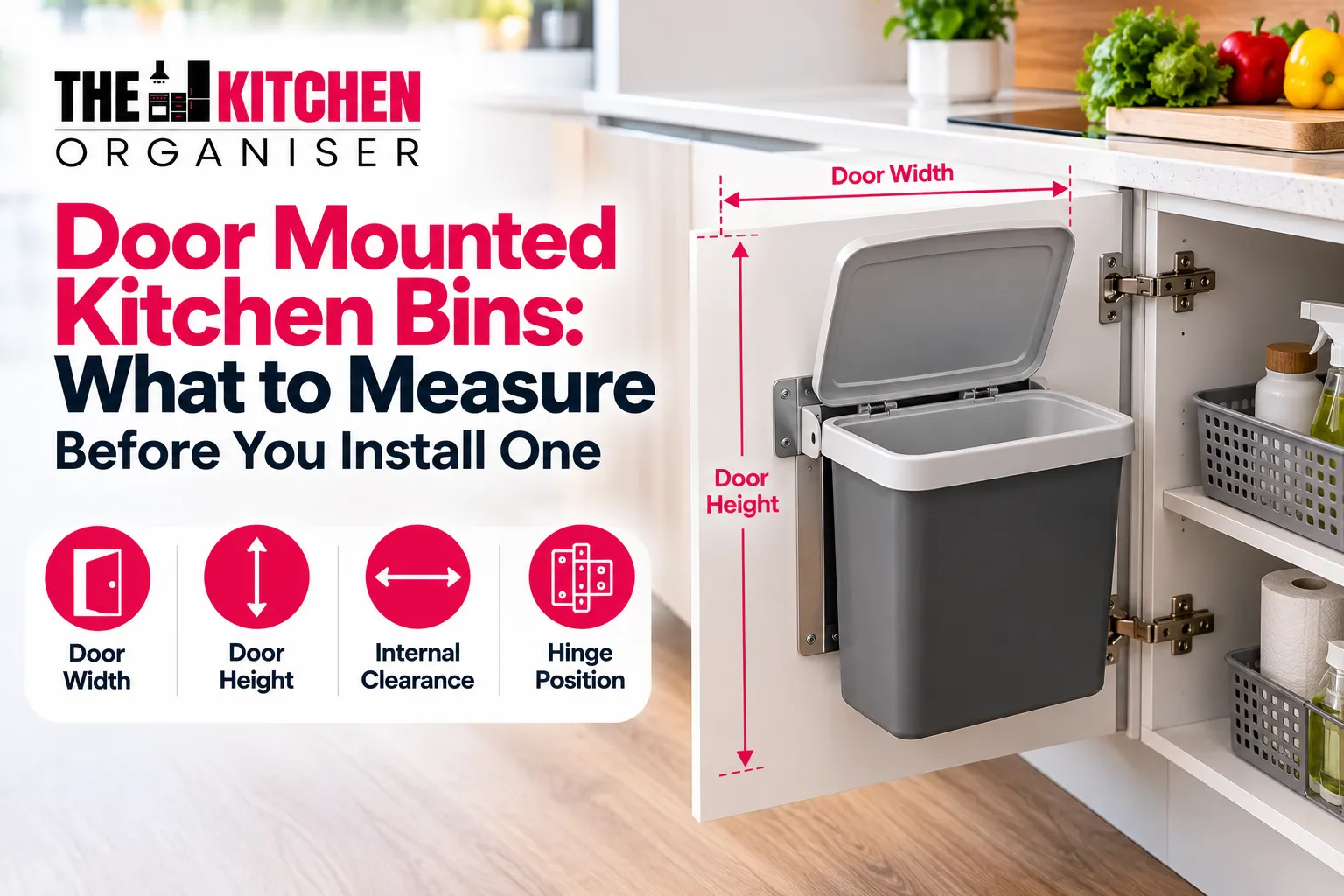
Door mounted kitchen bins are one of the simplest ways to get rubbish off the floor, especially in a small kitchen where every centimetre counts. The catch is that they’re less forgiving than a freestanding bin. A door mounted bin has to clear hinges, pipes and the cabinet frame every time the door swings, and it has to carry its own weight without sagging. Ten minutes with a tape measure before you order a door mounted waste bin can save you a return, a second trip to the hardware store or a damaged cupboard door.
How Door Mounted Bins Work
Not every door mounted bin works the same way, and the style affects what you need to measure.
-
Door-hung bins fix directly to the inside of the cupboard door. They’re compact, affordable and suit light everyday rubbish.
-
Door-operated bins sit on a frame inside the cabinet. When you open the door, the bin swings out and the lid lifts automatically.
-
Door-linked pull-outs run on cabinet runners, with a bracket connecting the frame to the door. The runners carry the weight, so the door simply draws the bin forward.
If you want a larger capacity or two buckets for rubbish and recycling, the second or third style is usually the safer choice, because the door isn’t taking the full load.
The Six Measurements to Take Before You Buy
Choosing a door mounted waste bin comes down to six measurements. Record each one in millimetres and compare it with the internal cabinet size the product lists, not the cabinet’s nominal width.
-
Internal width: measure between the side panels at the front, middle and back, and use the narrowest figure. A 450 mm cabinet won’t give you 450 mm of clear space.
-
Internal depth: measure from the back of the closed door to the rear wall or the nearest pipe.
-
Usable height: measure from the cupboard floor to the lowest obstruction, which under a sink is usually the bowl or trap.
-
Door size and thickness: the bracket needs a flat, solid area, and screws must be shorter than the door is thick.
-
Hinge clearance: check that the hinge arms don’t project into the bin’s path as the door opens.
-
Opening angle: make sure the door opens far enough to lift the bucket out, and that it won’t hit an appliance or the neighbouring door.
Leave a little headroom too, so the lid can lift and the bucket can come out for emptying.
Check the Weight Before You Choose the Capacity
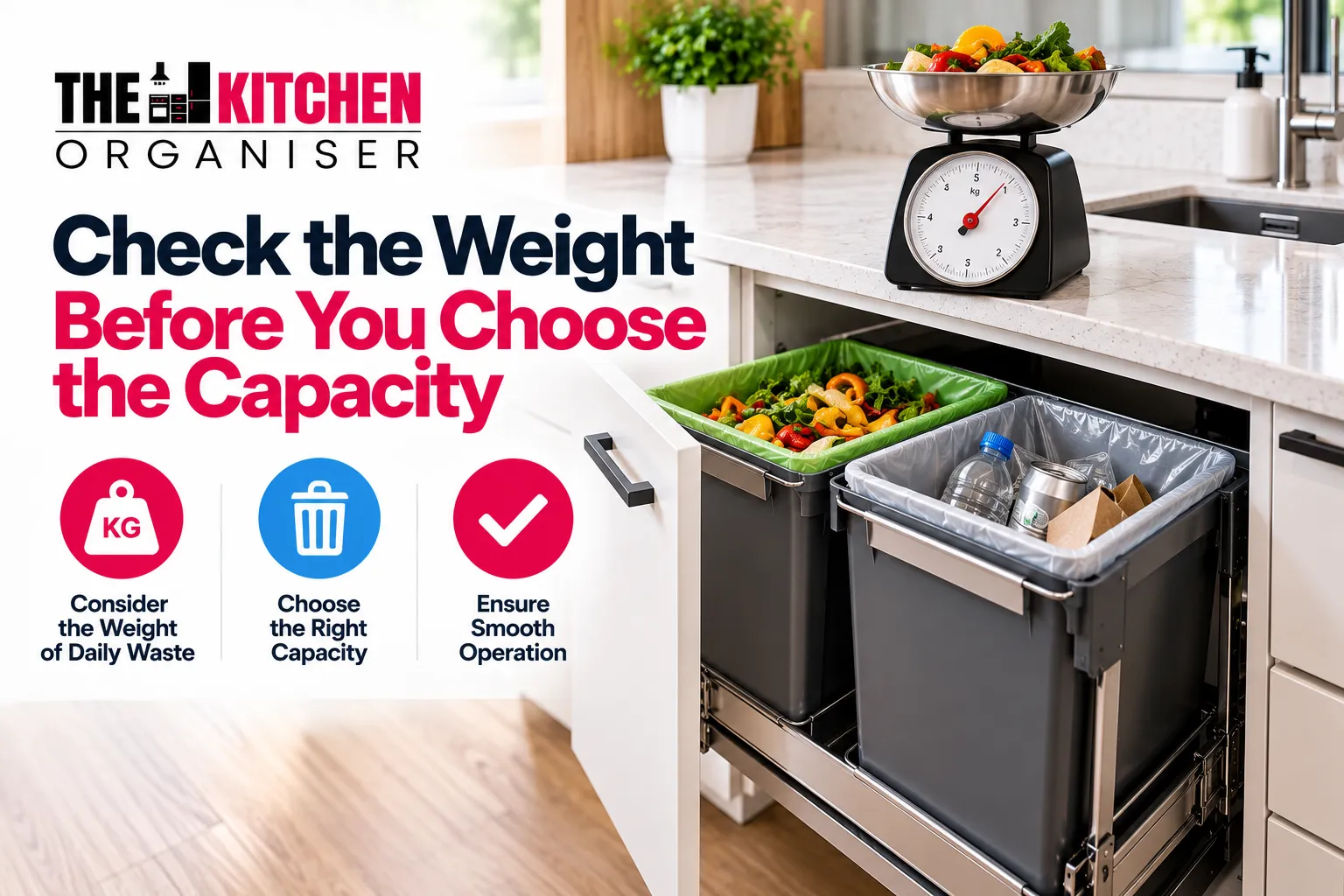
A full bin is heavier than most people expect once food scraps and bottles go in. If the bin hangs on the door, all of that weight sits on the hinges, so check the manufacturer’s load limit and be honest about how full it will get. Larger door mounted kitchen bins solve this by carrying the load on cabinet runners instead.
|
Feature |
Door-hung bin |
Door-linked pull-out |
|
What carries the weight |
Door and hinges |
Cabinet runners |
|
Typical capacity |
Compact |
Compact to large |
|
Best for |
Light waste, small kitchens |
Families, rubbish plus recycling |
A useful rule: if your current bin fills in a day or two, choose a runner-supported system and let the door do the opening, not the lifting.
Why Choose The Kitchen Organiser?
The Kitchen Organiser specialises in concealed waste systems for Australian kitchens, with a dedicated door-mount range.
-
Door-mount and door-operated bins in single and double configurations.
-
Trusted brands, including Wesco and Kia Ora.
-
Brackets and parts sold separately, such as the Kia Ora OPTIO door-mounted bracket, so check whether a listing is a complete system or an add-on.
-
Free shipping Australia-wide on orders over $200.
About Us
The Kitchen Organiser is an online store serving Australian households who want more from their kitchen storage. Our range spans kitchen bins, drawer and pantry organisers, corner fittings and laundry storage, all selected for build quality and a reliable fit. We believe small changes inside a cupboard can make a big difference to how a kitchen works every day.
Frequently Asked Questions About Door Mounted Bins
What are door bins?
Door bins are rubbish bins that attach to, or open with, a kitchen cupboard door. Some hang directly on the inside of the door, while others sit on a frame that swings or slides out as the door opens. They keep rubbish out of sight, free up floor space and suit compact kitchens.
What are the three types of garbage bins?
In Australia, the three main household garbage bins are general waste (usually a red lid), recycling (yellow lid) and organics (green lid) for garden waste and, in many areas, food scraps. Colours and rules vary by council. Inside the kitchen, the three common bin designs are freestanding, pull-out and door-mounted.
What is the best type of bin to use in a kitchen?
The best kitchen bin is a concealed one that suits your cabinet. A double pull-out works well for families who recycle, a door mounted bin suits compact kitchens and narrow cupboards, and a freestanding pedal bin suits renters who can’t modify cabinets. Whichever you choose, look for removable buckets and a hands-free lid.
How to attach a bin to a cupboard door?
To attach a bin to a cupboard door:
-
Check the door is solid and the hinges are tight.
-
Hold the bracket or template in place, clear of the hinges.
-
Mark the fixing points.
-
Drill pilot holes with a depth stop so you don’t break through the front.
-
Screw on the bracket using screws shorter than the door thickness.
-
Hang the bin and test the door through its full swing.
Final Thoughts
A door mounted bin is a small upgrade that frees up floor space and keeps rubbish within easy reach. Measure the width, depth, height and hinge clearance, check the weight limit, and pick a style that matches how much waste you produce. Do that first and installation is usually a quick afternoon job.