

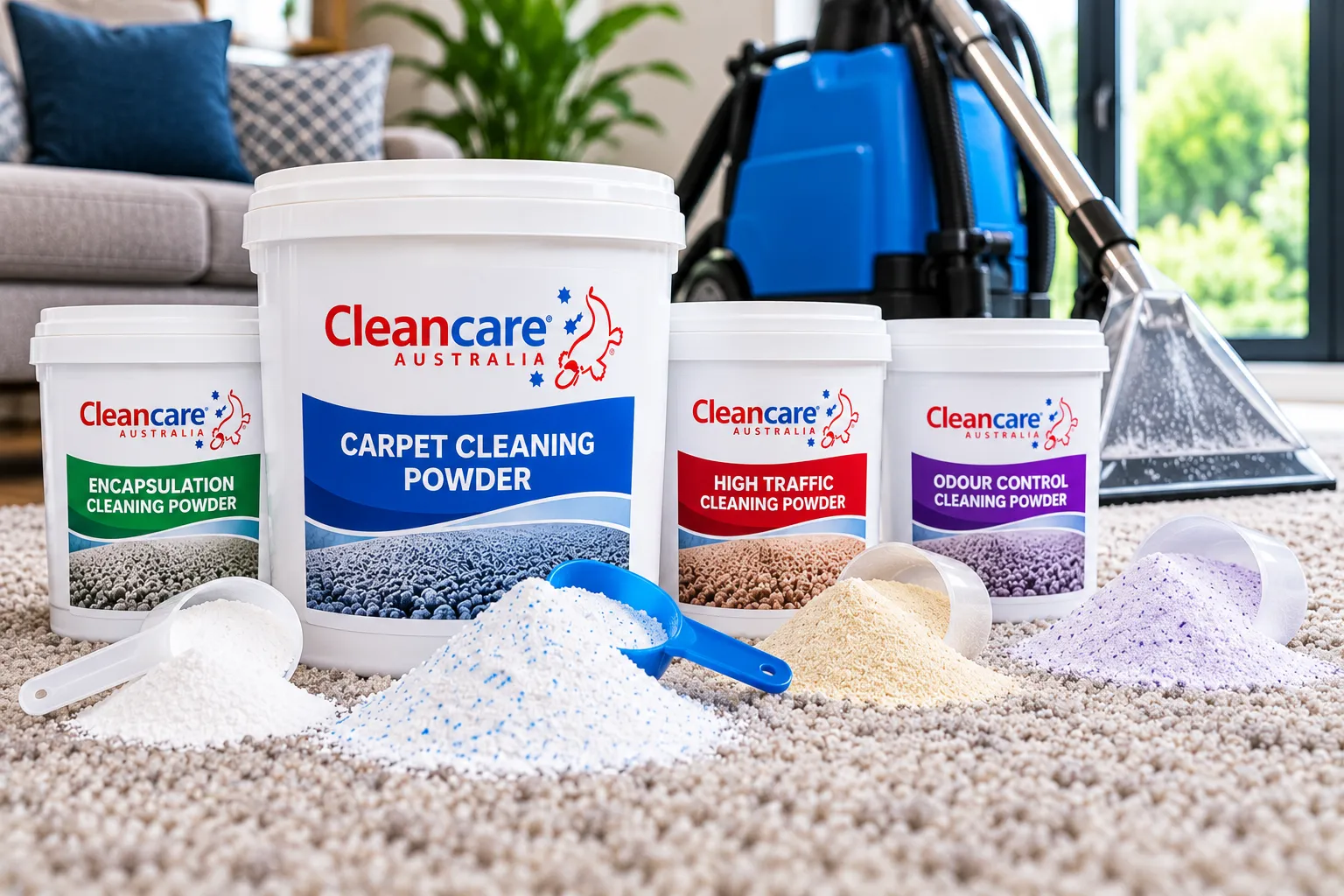
“Carpet powder” sounds like one product, but the name covers three very different things. One is a professional detergent you dissolve in water and run through an extraction machine. Another is a damp compound you brush into the pile and vacuum out. The third is a scented sprinkle that freshens a room without really cleaning it. Pick the wrong one and you’ll either waste your time or leave a mess in the carpet.
Here’s how to tell them apart, and how to use each one properly.
What is carpet cleaning powder?
Carpet cleaning powder is any powdered product used to clean or freshen carpet, and it falls into three groups:
-
Extraction detergent powder. A concentrated carpet cleaning powder that is dissolved in water and used in a hot water extractor or truck mount. This is what most professional carpet cleaners mean by the term.
-
Dry cleaning compound. Slightly damp absorbent granules carrying detergent. They’re brushed into the carpet with a machine, left to absorb soil, then vacuumed out. The carpet is usable again far sooner than after a wet clean.
-
Deodorising powder. A fragranced sprinkle, often based on baking soda, that is vacuumed up after a short wait. It masks or absorbs smells but doesn’t remove soil.
|
Extraction powder |
Dry compound |
Deodorising powder |
|
|
How it’s used |
Dissolved in water, run through a machine |
Brushed in, then vacuumed out |
Sprinkled, then vacuumed |
|
What it removes |
Traffic soil, oils, built-up grime |
Surface and light soil |
Odour only |
|
Moisture |
Wet clean, dries in hours |
Very low |
None |
|
Best for |
Deep cleaning |
Maintenance and quick turnarounds |
Freshening between cleans |
How does a powdered extraction detergent work?
Once it’s dissolved, it works like any carpet detergent: surfactants and alkaline builders loosen oily traffic soil so the extractor can rinse it out. The powder form simply means you aren’t paying to ship and store water.
Formula 90 is a typical example of this kind of carpet powder. Its directions call for dissolving it in cold or warm water, no hotter than 50°C, before it goes into the machine. For a portable extractor, that’s one scoop of roughly 75–100 g per 25 litres, pre-dissolved in about 3 litres of warm water. The same powder doubles as a pre-spray at 200 g per 10 litres, left to dwell for two to five minutes. Mix only what you’ll use that day, because the defoaming agents work best within about ten hours.
Strength matters too. A working solution buffered to pH 10–11.5 suits nylon, polypropylene and other synthetic carpet, but it’s too alkaline for wool and stain-resistant fibres. Those need a milder product, around pH 7.5–9, or a much weaker mix followed by an acidic rinse.
Is carpet powder better than a liquid detergent?
Not automatically. Form doesn’t decide cleaning strength; the formulation does. A neutral liquid and an alkaline powder are different products, whatever the packaging.
Where powder wins is practicality. It carries no water, so a bag is lighter to freight, smaller to store and keeps for a long time if it stays sealed and dry. For anyone cleaning every week, that usually means a lower cost per tank. Liquids win on speed and accuracy in small batches, and many of the gentler wool-safe detergents come as liquids.
How do you choose a carpet powder cleaner?
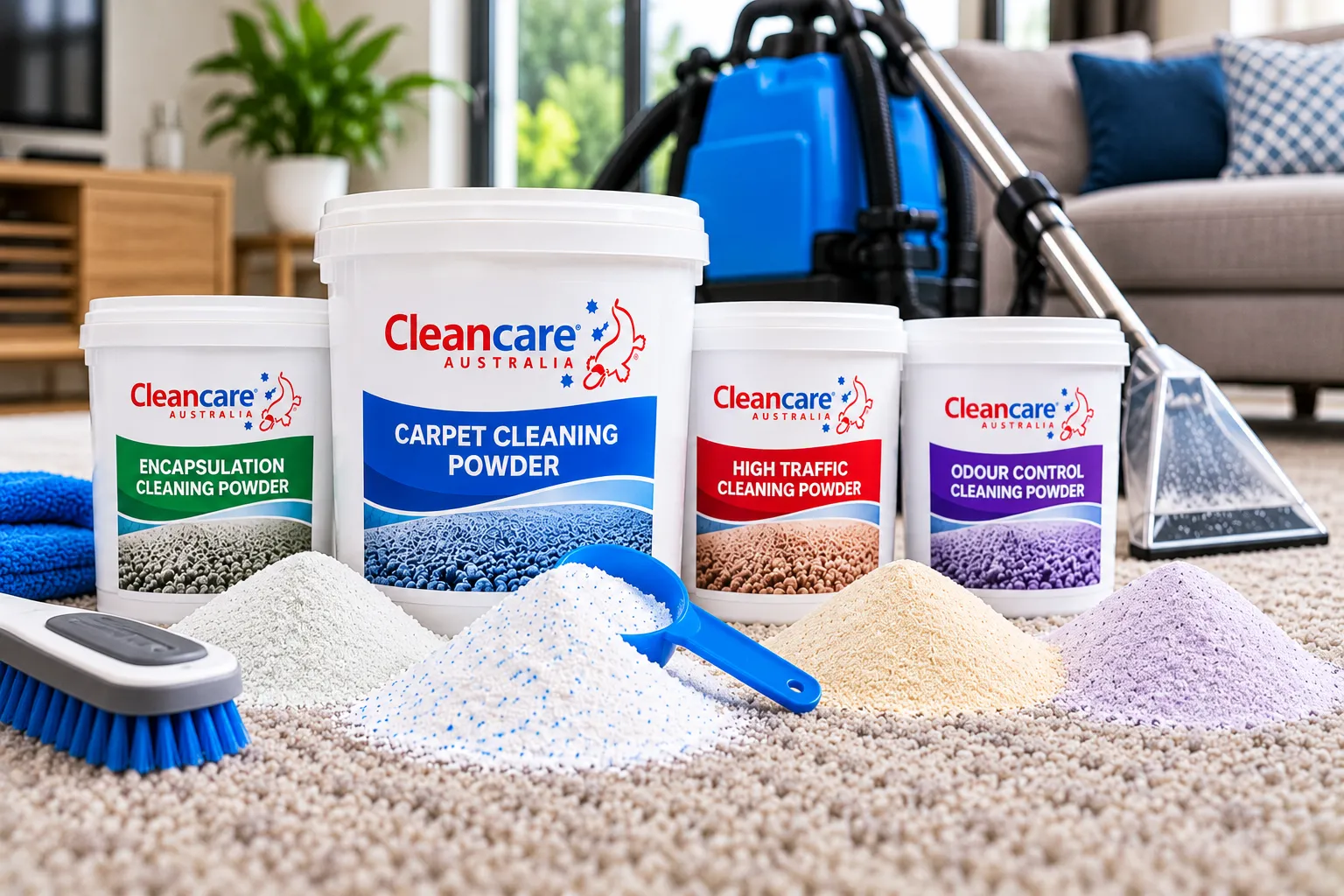
Run through these checks before you buy a carpet powder cleaner:
-
Fibre. Match the product’s pH to the carpet. Alkaline powders suit synthetics; wool and stain-resistant nylon need something milder.
-
Machine. An extraction powder should contain defoamers so it behaves in the recovery tank. A dry compound needs a brush machine to work it in.
-
Soil. Heavy traffic lanes justify a heavy-duty powder plus a pre-spray. Light soil doesn’t.
-
Cost per tank. Divide the pack price by the number of tanks it makes at the label rate. Many powders come in small packs, so trial one before buying a 19 kg bag.
-
Safety. Concentrated alkaline powders can irritate skin and eyes, so read the Safety Data Sheet and wear gloves when measuring.
How do you use powdered carpet detergent?
-
Vacuum slowly, in two directions.
-
Dissolve the measured powder in a bucket of warm water first, then add it to the solution tank. Undissolved granules can block filters and jets.
-
Pre-spray traffic lanes and let them dwell for a few minutes.
-
Extract with overlapping passes, finishing each section with a couple of dry vacuum strokes.
-
Follow an alkaline powder with an acidic rinse to neutralise any residue.
-
Dry with open windows or fans, and keep foot traffic off until the carpet is dry.
Frequently Asked Questions
Does carpet powder really work?
Yes, if you use the right type for the job. Extraction powders dissolved in water are what many professional carpet cleaners use for deep cleaning. Dry compounds work well for low-moisture maintenance. Deodorising sprinkles only freshen the smell; they don’t remove dirt.
What powder do you use on carpet?
For deep cleaning, a powdered extraction detergent dissolved in water and run through a carpet extractor. For quick low-moisture cleans, a dry compound brushed in with a machine and vacuumed out. Never sprinkle an extraction powder straight onto carpet, because it’s made to be dissolved first.
Is carpet powder just baking soda?
No. Baking soda (sodium bicarbonate) can absorb some odours, but it has no surfactants to lift oily soil. Professional carpet powders contain detergents, builders and defoamers. Baking soda’s fine particles also settle deep in the pile and can clog vacuum filters if you use a lot.
The Bottom Line
Before you buy carpet cleaning powder, decide whether you need to deep clean, maintain or just freshen. Then choose a carpet powder cleaner that suits the fibre, follow the label rate, and rinse after any alkaline powder.